
Home/Products/Oil Seals (Rotary Shaft Seals)

Product

Oil Seals (Rotary Shaft Seals)

Lip-type rotary shaft seals that retain lubricant and exclude contaminants around rotating shafts, built to metal-case or rubber-covered OD designs with single or double lip configurations.
Gearboxes, motors, pumps, automotive drivetrains, industrial rotating equipmentTypical applications
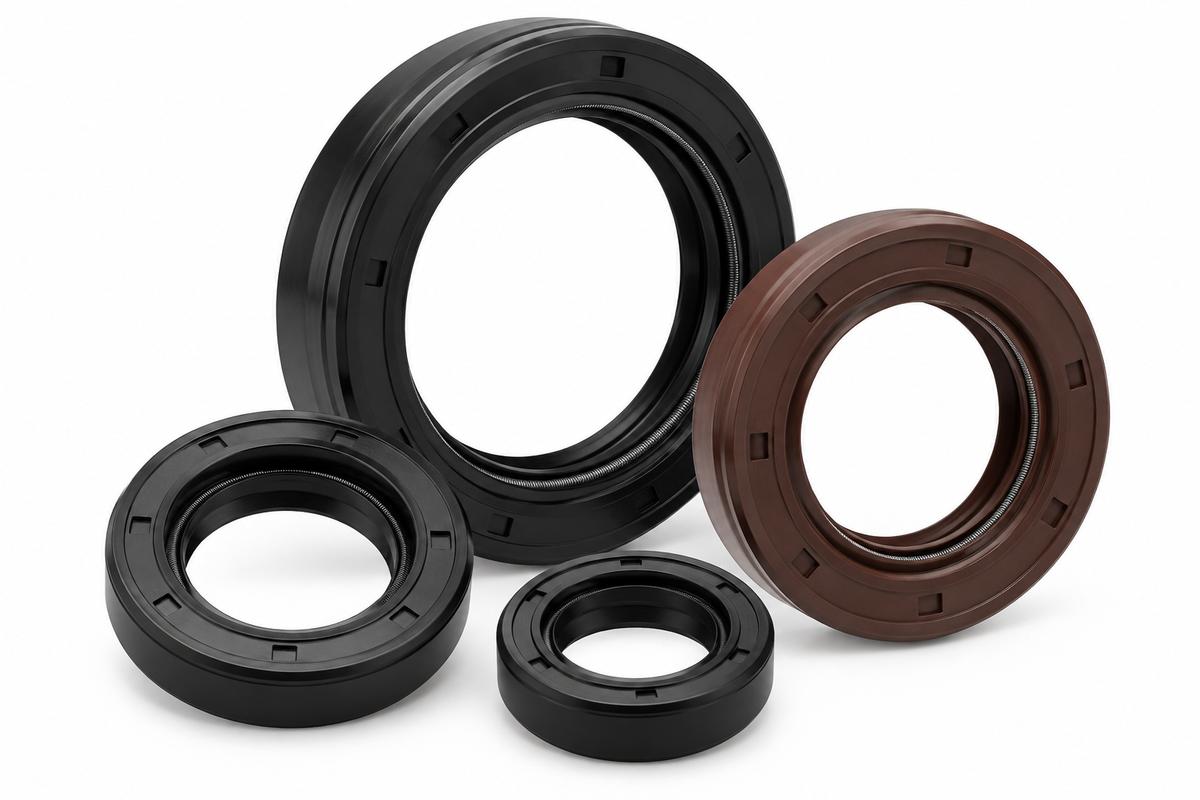
FITCO oil seals — TC type rotary shaft seals

TC-type rotary shaft oil seals in various sizes for gearboxes, motors and pumps.

Overview

What it is

An oil seal (rotary shaft seal) is a lip-type seal fitted around a rotating shaft to retain lubricant inside a housing — a gearbox, motor, pump or bearing — while excluding dirt and moisture from outside.

A spring-loaded elastomer lip rides against the rotating shaft under light, continuous pressure, maintaining a thin oil film that lubricates the lip-to-shaft contact while still forming a seal; the seal's metal case presses into the housing bore as a static fit.

Why use it

Key benefits

  • Continuous dynamic sealing against a rotating shaft, not just a static joint
  • Garter-spring-loaded lip maintains contact as it wears
  • Single- or double-lip configurations — double lip adds a secondary dirt-exclusion function

Materials

Which compound, and why

Material

NBR (Nitrile / Buna-N)

The standard oil-seal compound — good mineral-oil and moderate-heat resistance at low cost.

Material

FKM / FPM (Fluoroelastomer)

Higher-temperature service or synthetic lubricants beyond NBR's range.

Material

HNBR (Hydrogenated Nitrile)

Where NBR runs too hot or wears too quickly — added heat and abrasion resistance.

Applications

Where it's used

Gearboxes, motors, pumps, automotive drivetrains, and industrial rotating equipment.

Specifications

Oil seal technical resources

Spec

Oil Seal Description & Types

TC, TB, SC, SB, VC, KC type codes — lip materials and construction details.

Spec

Installation Guide

Step-by-step fitting instructions, shaft surface finish requirements and common errors.

Spec

Press Fit & Housing Tolerances

Housing bore tolerances, eccentricity limits and chamfer dimensions by shaft diameter.

Spec

Interchange / Cross-Reference Table

Cross-reference FITCO types against SKF, NOK, Freudenberg and Parker equivalents.

Spec

Size Range Chart

Complete oil seal dimensions — shaft 6 mm to 500 mm with bore and width.

Spec

Viton / FKM Oil Seals

High-temperature FKM oil seals for synthetic lubricants and aggressive chemicals.

How Oil Seals Work

A rotary shaft oil seal, also known as a radial lip seal, creates a dynamic sealing interface between a rotating shaft and the stationary housing bore. The seal lip rides on the shaft surface under light spring-loaded pressure, forming a thin lubricant film that prevents oil leakage while minimising friction and wear. The garter spring behind the lip maintains consistent radial force as the lip wears over time, extending the service life of the seal.

Oil seals are directional — they are designed to retain lubricant on one side while excluding contaminants from the other. Dual-lip (TC type) seals add a secondary dust lip on the air side that blocks dirt, moisture and abrasive particles from reaching the primary sealing edge, making them the preferred choice in dusty or wet operating environments.

Oil Seal Types and Profiles

FITCO manufactures oil seals in all standard profile configurations. SC type (single lip with spring) is the basic rotary shaft seal for clean environments. TC type (double lip with spring) adds a dust-exclusion lip and is the most widely used configuration. SB and TB types feature an outer metal case fully bonded to rubber, providing a superior static seal at the bore. SA and TA types have an exposed outer metal shell for interference-fit installation into metal housings. VC type seals have a completely rubber-covered exterior for applications requiring vibration dampening. DC-DS type double-case seals offer maximum protection in heavy-duty and high-contamination environments.

Technical Specifications

Our oil seals are manufactured to cover shaft diameters from 6 mm to 250 mm with bore diameters from 16 mm to 280 mm. Standard widths range from 7 mm to 15 mm depending on size. Operating temperature ranges from –40 °C to +200 °C depending on material selection — NBR seals handle up to 120 °C, FKM (Viton) seals to 200 °C, and Silicone seals from –60 °C to +180 °C. Maximum shaft speed depends on the shaft diameter and surface finish: up to 12 m/s peripheral velocity is standard, with higher speeds achievable using PTFE lip seals.

Shaft surface finish is critical for oil seal performance. We recommend Ra 0.2–0.5 µm with no machining lead, and hardness of 45 HRC minimum on the shaft running surface. The housing bore should have Ra 1.6–3.2 µm for rubber-covered OD seals or Ra 0.8–1.6 µm for metal-cased seals.

Applications

Oil seals are used wherever a rotating or reciprocating shaft passes through a housing containing lubricant. Common applications include gearbox input and output shafts, engine crankshafts and camshafts, wheel hubs, hydraulic pumps and motors, compressor shafts, conveyor drives, mixer shafts, agricultural machinery, and electric motor housings. In the automotive sector alone, a typical passenger car contains 15–25 oil seals across the engine, transmission, differential and axle assemblies.

📐 Oil Seal Size Chart Request a Quote

Get a quote on your O-ring or sealing requirement

Send drawings, sizes, materials or an existing part number — our engineering team will respond with pricing, lead time and technical guidance.

Request a Quote Browse Technical Resources