Home/Products/Elastic Spiders

Product

Elastic Spiders

An elastic spider (jaw-coupling insert) is a star-shaped elastomer element fitted between two toothed coupling hubs, transmitting torque between two shafts while its lobes flex to absorb misalignment and shock.
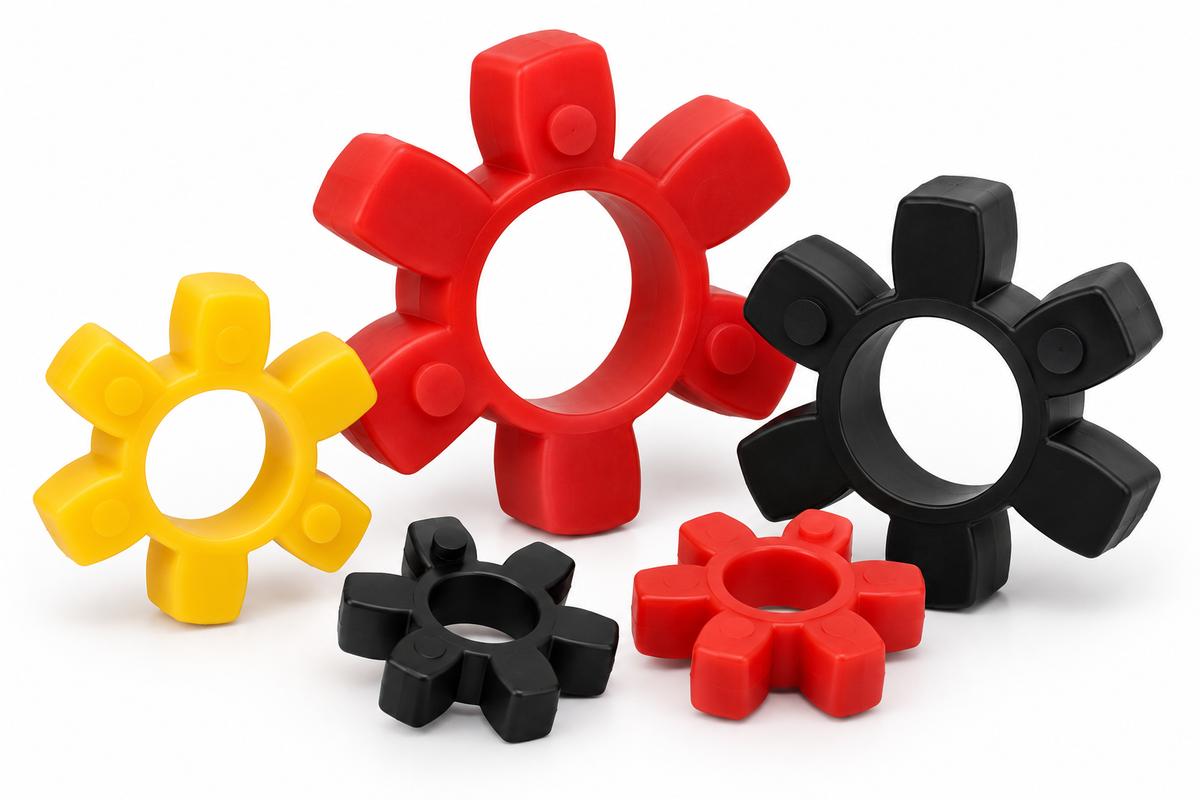
FITCO elastic spider jaw coupling elements

Overview

How it works

The spider's lobes sit compressed between the jaws of two facing hub halves. As torque is transmitted, the lobes are loaded in compression rather than shear, which is what lets the coupling absorb angular, parallel and axial misalignment between the two shafts, along with cushioning torque shocks and vibration that would otherwise be transmitted straight through a rigid coupling.

Profiles

Available profiles

Profile

GR

Elastomer coupling insert profile.

Profile

GS

Elastomer coupling insert profile.

Profile

MT

Elastomer coupling insert profile.

Profile

SBT

Elastomer coupling insert profile.

Profile

H

Elastomer coupling insert profile.

Profile

Flender

Elastomer coupling insert profile.

Materials

Which compound, and why

Material

Polyurethane (PU)

The standard spider material — high tensile strength and abrasion resistance for continuous power-transmission duty.

Material

NBR

A softer, lower-cost alternative where shock absorption matters more than maximum torque capacity.

Applications

Where used

Shaft and jaw couplings in general engineering and hydraulic power-transmission applications — pumps, motors, gearboxes and conveyor drives.

What Elastic Spiders Do

Elastic spiders (coupling elements or jaw inserts) are star-shaped elastomer components that fit between the jaws of a flexible jaw coupling, transmitting torque while absorbing shock loads, torsional vibration and angular, parallel and axial misalignment between two connected shafts. They are the sacrificial wear element in the coupling — designed to fail before the metal coupling halves or connected machinery are damaged.

The elastomer spider compresses between alternating jaws of the driving and driven coupling halves. As torque is transmitted, the spider legs deform slightly, providing a cushioning effect that smooths out torque pulsations from engines, compressors and other pulsating loads. This vibration damping protects gearboxes, bearings, seals and other downstream components from fatigue damage.

Spider Types and Hardness Selection

Spiders are available in multiple hardness grades to match the application: 98 Shore A (red) for maximum torque capacity and minimum backlash; 92 Shore A (yellow) for general-purpose industrial drives; 80 Shore A (green/blue) for high vibration damping and shock absorption; 64 Shore A (white/natural) for maximum flexibility and misalignment tolerance. Softer spiders absorb more vibration but have lower torque capacity; harder spiders transmit more torque but provide less damping.

Get a quote on your O-ring or sealing requirement

Send drawings, sizes, materials or an existing part number — our engineering team will respond with pricing, lead time and technical guidance.

Request a Quote Browse Technical Resources