
Material
NBR (Nitrile / Buna-N)
NBR (Nitrile / Buna-N) is the workhorse elastomer of the sealing industry — a synthetic copolymer of butadiene and acrylonitrile, first patented in 1934. Its acrylonitrile (ACN) content, typically ranging from 14% to 50%, is tuned to trade off oil resistance against low-temperature flexibility. Higher ACN content improves resistance to petroleum oils and fuels but raises the glass transition temperature, reducing cold-weather performance. Standard, medium and high-ACN grades cover the majority of mineral-oil and fuel-sealing applications at commodity cost.
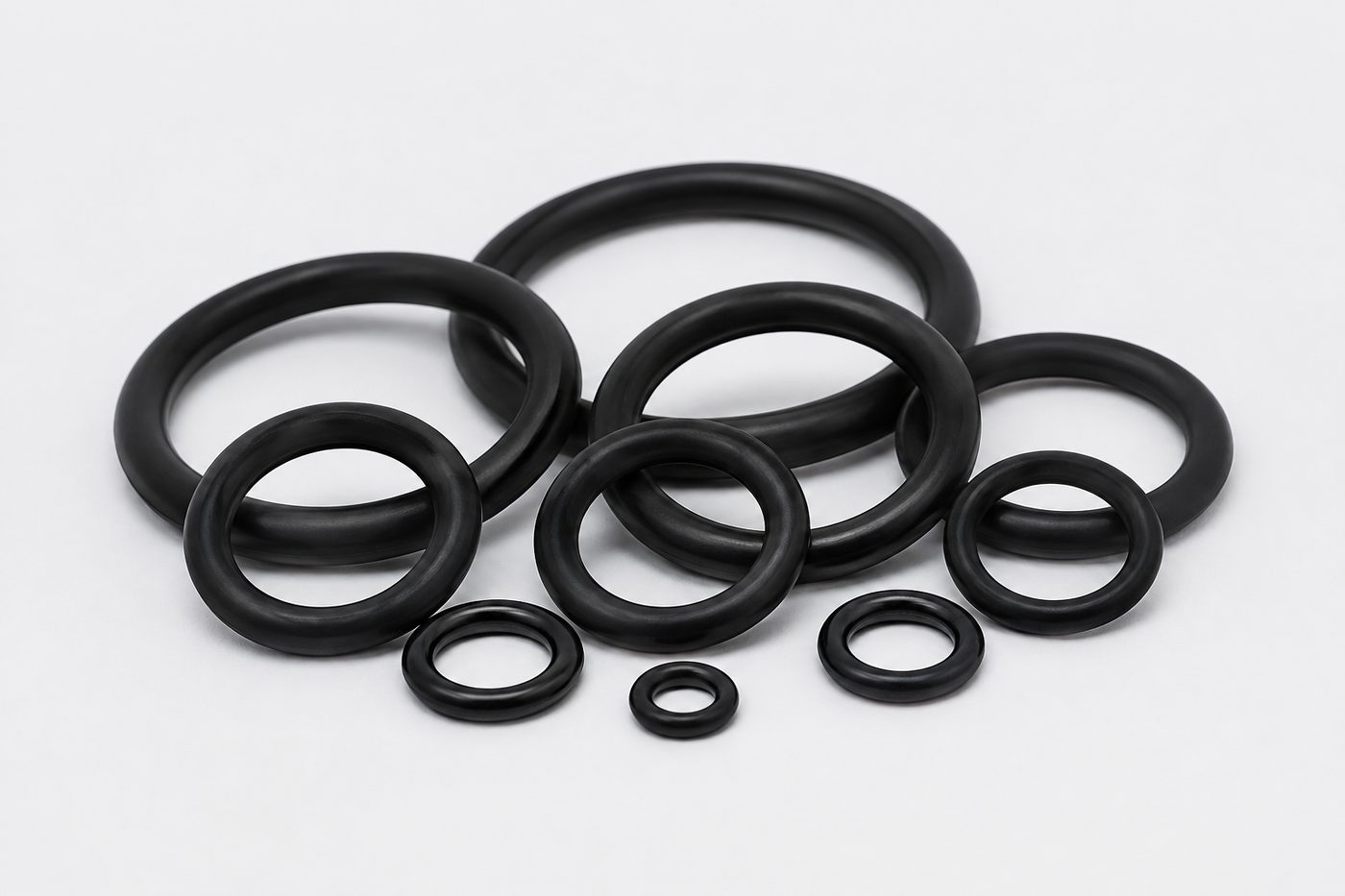
NBR O-rings — the general-purpose compound.
Material Science
Understanding NBR composition
NBR is a synthetic copolymer of acrylonitrile and butadiene, also known under trade names such as Nipol, Krynac, and Europrene N. The ratio of acrylonitrile to butadiene determines the compound's performance characteristics:
| ACN Content | Grade | Oil Resistance | Low-Temp Flexibility | Typical Use |
|---|---|---|---|---|
| 18–22% | Low ACN | Moderate | Excellent (to -55°C) | Military, aerospace cold-weather seals |
| 28–34% | Medium ACN | Good | Good (to -40°C) | General industrial, automotive |
| 36–42% | High ACN | Very Good | Moderate (to -25°C) | Fuel systems, oil-immersed seals |
| 43–50% | Very High ACN | Excellent | Limited (to -15°C) | Aggressive fuel and solvent exposure |
Performance
Key advantages
Oil & Fuel Resistance
Excellent resistance to petroleum-based oils, fuels, mineral oils, and hydraulic fluids. The most economical elastomer for hydrocarbon sealing applications.
Mechanical Strength
High tensile strength, outstanding abrasion and tear resistance, good rebound resilience. Performs well in both static and dynamic sealing applications.
Low Gas Permeability
Among the lowest gas permeability of common elastomers, making it suitable for pneumatic systems and gas-handling equipment.
Cost Effectiveness
Significantly lower cost than fluoroelastomers (FKM) and perfluoroelastomers (FFKM) while covering a wide range of sealing needs. The most specified elastomer worldwide.
Compression Set
Good compression set resistance ensures reliable long-term sealing performance. Maintains seal integrity under sustained loading in groove applications.
Water Resistance
Good resistance to water, aqueous solutions, and dilute acids and alkalis. Suitable for water-based hydraulic fluids and coolant systems.
Limitations
Where NBR is not recommended
While NBR is versatile, it should not be used in the following environments:
Ozone & UV Exposure
NBR has poor resistance to ozone, sunlight, and weathering. Outdoor or ozone-rich environments cause surface cracking and degradation. Use EPDM or FKM instead.
Polar Solvents
Ketones (acetone, MEK), esters, chlorinated hydrocarbons, and nitro-hydrocarbons cause excessive swelling. Use FKM or FFKM for these media.
High Temperatures
Standard NBR grades are limited to 120°C continuous service. For temperatures above 150°C, specify FKM or HNBR compounds.
Automotive Brake Fluid
Glycol-based brake fluids (DOT 3, DOT 4) attack NBR. Use EPDM O-rings for brake system applications.
Applications
Where it's used
Hydraulic & Pneumatic Systems
Cylinder seals, piston seals, rod seals, valve seals. The default elastomer for mineral-oil hydraulic circuits operating at moderate temperatures.
Automotive & Off-Highway
Transmission seals, engine oil seals, fuel-system O-rings, V-belts, hoses, and coolant system gaskets. One of the most widely used automotive seal materials.
Oil & Gas
General-purpose seals for production equipment, pipeline fittings, compressor seals, and lubricating-oil systems where temperatures remain moderate.
Industrial Equipment
Pumps, valves, compressors, gearboxes, filtration systems, and general-purpose industrial fluid-handling equipment.
Available as
O-rings & products in this material
 O-Ring Standard
AS568 O-Rings
AS568 (Aerospace Size Standard 568) defines the inch-based dash-numbered O-ring sizes used as the de-facto glo…
View details →O-Ring Standard
Metric O-Rings
Metric O-rings are specified by inside diameter and cross-section in millimetres and are the default on Europe…
View details → O-Ring Standard
ISO 3601 O-Rings
ISO 3601-1 defines metric O-ring dimensions and tolerance classes (Class A/B) and ISO 3601-2 defines gland dim…
View details →O-Ring Standard
Custom O-Rings
Where a standard AS568, metric or ISO 3601 size does not fit the application, FITCO produces custom O-rings to…
View details →