
Home/Products/PTFE Seals & Components

Product

PTFE Seals & Components

Machined and molded PTFE seals, backup rings and encapsulated (elastomer-core, PTFE-jacketed) O-rings for chemical inertness and low friction beyond what standard elastomers can provide.
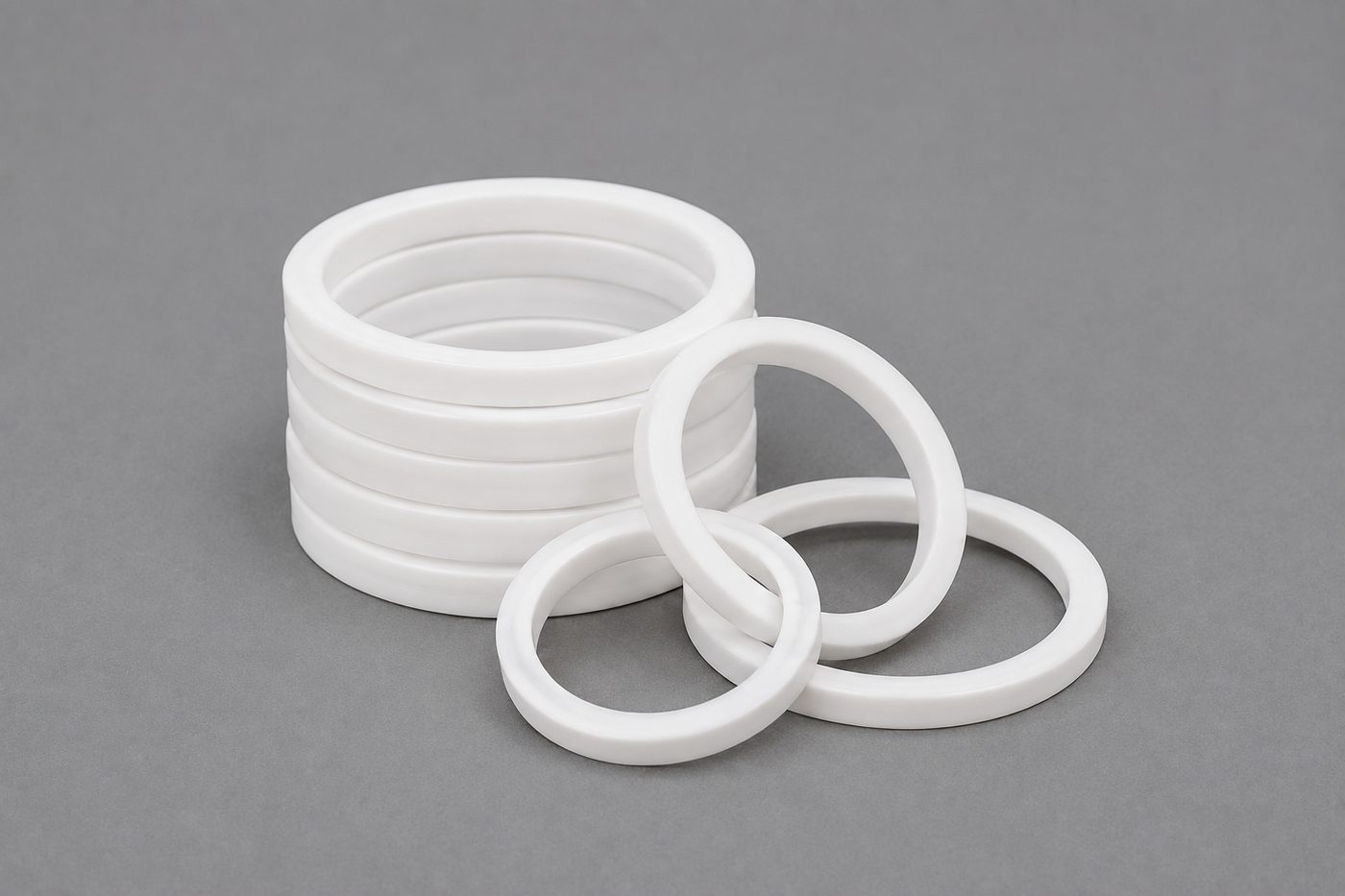
Chemical processing, semiconductor equipment, high-purity and high-temperature static sealsTypical applications
FITCO PTFE seals

PTFE seal components — chemically inert, low friction.

Overview

What it is

PTFE seals are seal components machined or molded from PTFE (polytetrafluoroethylene) rather than a rubber compound — used where chemical inertness or a very wide temperature range rules out elastomers entirely.

PTFE has no elastic memory the way rubber does, so PTFE seals are usually designed with a spring or elastomer energiser behind them to maintain sealing force, or are sized to be pressed into a controlled interference fit — the PTFE itself provides the chemically inert, low-friction sealing surface while the energiser supplies the mechanical loading.

Why use it

Key benefits

  • Near-universal chemical resistance — acids, solvents, steam, aggressive process chemicals
  • Usable from cryogenic to roughly +260°C depending on grade
  • Very low coefficient of friction — suited to dry-running or lightly lubricated dynamic seals

Materials

Which compound, and why

Material

PTFE (Virgin, Glass, Bronze, Graphite)

Virgin PTFE for maximum chemical inertness and cryogenic service; glass-, bronze- or graphite-filled grades where extra wear resistance, hardness or thermal conductivity is needed.

Applications

Where it's used

Chemical processing, semiconductor equipment, and high-purity or high-temperature static seals beyond what standard elastomers can handle.

Advantages of PTFE Seals

PTFE (polytetrafluoroethylene) seals offer a unique combination of properties: the lowest friction coefficient of any solid material (0.05–0.10), near-universal chemical resistance, an operating temperature range from –200 °C to +260 °C, and no stick-slip behaviour even at very low speeds. These properties make PTFE seals the preferred choice for applications where elastomer seals cannot perform — extreme temperatures, aggressive chemicals, ultra-clean environments or applications requiring the lowest possible friction.

PTFE is not elastic — it does not spring back like rubber. PTFE seals therefore require an elastomer energiser (typically an O-ring) behind them to provide the recovery force needed to maintain lip contact. The PTFE element provides the low-friction sliding surface, while the O-ring energiser compensates for wear and thermal expansion. This two-piece design gives PTFE seals much longer life than single-material elastomer seals in demanding applications.

PTFE Seal Materials

Virgin PTFE offers the best chemical resistance and lowest friction but has limited wear resistance and tends to creep under sustained load. Glass-filled PTFE (15–25% glass fibre) provides significantly better wear resistance and dimensional stability, suitable for most hydraulic applications. Bronze-filled PTFE (40–60% bronze powder) offers the highest wear resistance and thermal conductivity, ideal for high-speed and high-load applications. Carbon-filled PTFE provides good wear resistance with improved thermal conductivity in chemically aggressive environments. Graphite-filled PTFE offers self-lubricating properties for applications with minimal lubrication.

Get a quote on your O-ring or sealing requirement

Send drawings, sizes, materials or an existing part number — our engineering team will respond with pricing, lead time and technical guidance.

Request a Quote Browse Technical Resources