
Home/Products/Guide Rings

Product

Guide Rings & Guide Strips

A guide ring (wear ring) is a low-friction band fitted between a piston or rod and its bore, carrying the radial side-load of the assembly so the metal piston or rod never contacts the metal bore directly.
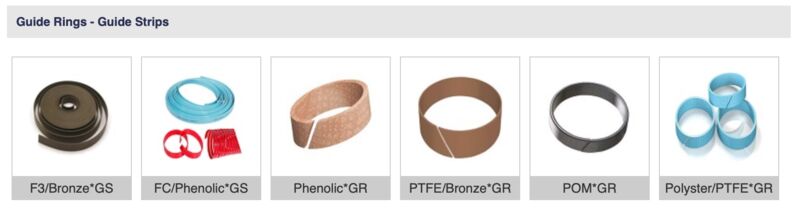
FITCO guide rings and strips
Guide ring and strip profiles - bronze, phenolic, PTFE, POM types

Guide ring/strip profiles: Bronze, Phenolic, PTFE, POM, and Polyester types.

Overview

Why a separate wear component

Seals are designed to seal, not to bear radial load — asking a rod or piston seal to also carry side-load from an off-centre or overhung cylinder load will wear it out prematurely and let the piston or rod drift into metal-to-metal contact with the bore. A guide ring is a dedicated bearing element that takes that radial load instead, protecting both the seals and the bore surface, and is sized as a slip fit rather than a compressed seal.

Materials

Which compound, and why

Material

PTFE (Bronze-filled)

The standard guide-ring material — low friction with the compressive strength to carry radial load.

Material

Phenolic / POM

Cotton-fabric-reinforced phenolic or acetal (POM) alternatives for lower-cost or lighter-duty guide rings.

Profiles

Available profiles

Profile

F3 / Bronze-filled GS

Profile

FC / Phenolic GS

Profile

Phenolic GR

Profile

PTFE/Bronze GR

Profile

POM GR

Profile

Polyester/PTFE GR

Applications

Where used

Mainly fitted on piston rods and pistons in hydraulic and pneumatic cylinders, particularly where the cylinder carries an off-centre or side load that would otherwise be borne by the seals.

Why Guide Rings Are Essential

Guide rings (also called wear rings or bearing strips) are installed on the piston and in the cylinder head to prevent metal-to-metal contact between the piston and cylinder bore, and between the rod and cylinder head. Without guide rings, side loads from the actuated machinery cause the piston and rod to bear directly against the cylinder bore and gland, resulting in scoring, accelerated seal wear, increased friction and ultimately cylinder failure.

In mobile hydraulic equipment — excavators, cranes, telescopic handlers — cylinders experience significant side loads from the weight and momentum of the attached implements. Guide rings absorb these radial forces, keeping the piston and rod centred and ensuring even pressure distribution across the seal faces. This dramatically extends the service life of both the seals and the cylinder itself.

Guide Ring Materials

PTFE/Bronze filled guide rings offer the best combination of low friction, high load capacity and excellent wear resistance. The bronze filler provides thermal conductivity to dissipate frictional heat and adds compressive strength. Phenolic resin guide rings are harder and more rigid, suitable for heavy-duty applications with high radial loads but requiring better surface finishes on the mating surfaces.

POM (Polyacetal/Delrin) guide rings provide good wear resistance at lower cost and are suitable for lighter-duty applications. Polyester/PTFE fabric guide rings offer exceptional load-bearing capacity and are used in large-bore, heavy-duty cylinders in mining and offshore applications. All materials are available as machined rings (GR type) or continuous strips (GS type) that are cut to length and installed in the groove.

Sizing and Installation

Guide ring dimensions are determined by the piston or rod diameter and the available groove width. Standard radial wall thicknesses range from 2.5 mm for small bores to 6 mm for large bores. The guide ring must have a small gap at the split joint to allow for thermal expansion during operation — PTFE-based rings require larger expansion gaps than phenolic rings due to PTFE's higher thermal expansion coefficient.

For optimal performance, guide rings should be installed in pairs — one on each side of the piston seal for piston guides, and one in the cylinder head for rod guides. The cylinder bore surface finish should be Ra 0.2–0.4 µm (honed) for best results. Guide rings should be replaced whenever the cylinder is resealed, as worn guides allow increased side loading on the new seals.

📐 Guide Ring Size Chart Request a Quote

Get a quote on your O-ring or sealing requirement

Send drawings, sizes, materials or an existing part number — our engineering team will respond with pricing, lead time and technical guidance.

Request a Quote Browse Technical Resources