
Home/Products/Backup Rings (Anti-Extrusion Rings)

Product

Backup Rings (Anti-Extrusion Rings)

PTFE, PEEK or elastomeric rings installed alongside an O-ring in the gland to prevent extrusion into the clearance gap at high pressure or elevated temperature.
High-pressure hydraulic systems, wide extrusion-gap glands, elevated-temperature service where the elastomer softensTypical applications
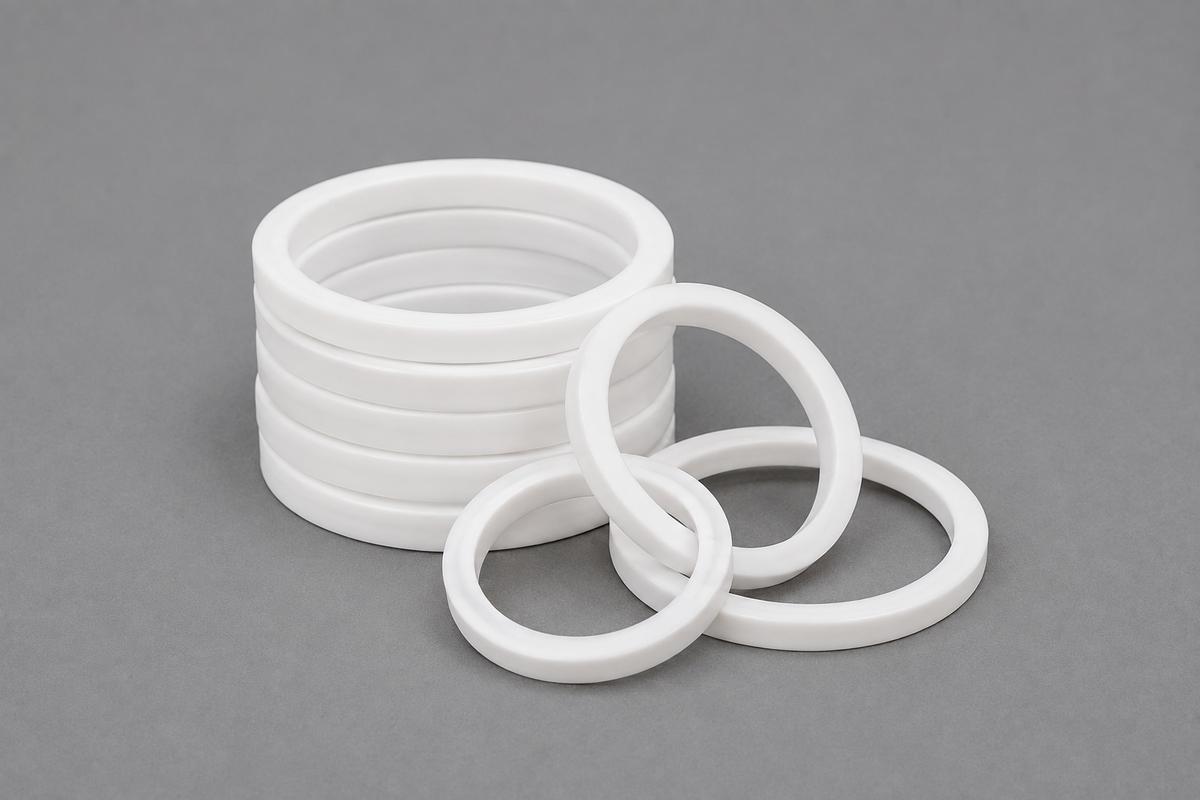
FITCO PTFE back-up rings

PTFE back-up rings, stacked and ready for dispatch.

Overview

What it is

A backup ring is not itself a seal — it's a ring of hard, extrusion-resistant material fitted on the low-pressure side of an O-ring or X-ring to close off the clearance gap between the two mating parts.

Under high pressure, an elastomer seal will slowly flow (extrude) into the clearance gap between the housing and the shaft or piston, eventually nibbling away at the seal until it fails. A backup ring physically blocks that gap, giving the elastomer seal nowhere to extrude into, which lets the same seal run at a higher pressure or wider clearance than it could on its own.

Why use it

Key benefits

  • Extends the pressure and temperature range of the primary seal
  • Available in single-turn (scarf-cut), spiral (multi-turn) and solid (uncut) configurations
  • Fits the same AS568/metric groove as the O-ring it supports
  • Can be fitted on one or both sides of the seal depending on whether pressure is one-directional or bi-directional

Materials

Which compound, and why

Material

PTFE (Virgin, Glass, Bronze, Graphite)

The standard backup-ring material — high compressive strength, wide temperature range, chemically inert; supplied virgin or glass/bronze filled for extra extrusion resistance.

Material

NBR (Nitrile / Buna-N)

90-durometer nitrile backup rings, a lower-cost option for moderate-pressure hydraulic service where PTFE isn't required.

Applications

Where it's used

High-pressure hydraulic and pneumatic cylinders, wide extrusion-gap glands, and elevated-temperature service where the primary elastomer softens and becomes extrusion-prone.

Understanding Extrusion and Why Backup Rings Matter

When an O-ring is subjected to high pressure, the elastomer is forced into the clearance gap between the mating hardware — a phenomenon called extrusion. At pressures above 70 bar (for static seals) or 35 bar (for dynamic seals), the extruded rubber can be sheared off, causing progressive seal damage and eventual failure. Backup rings fill the clearance gap, physically preventing the O-ring from extruding into it.

The need for backup rings depends on three factors: system pressure, clearance gap width, and O-ring hardness. Softer O-rings (70 Shore A) extrude at lower pressures than harder ones (90 Shore A). Larger clearance gaps permit extrusion at lower pressures. A properly sized backup ring allows the use of softer, more conformable O-rings at high pressures, giving better sealing without the risk of extrusion damage.

Single vs. Double Backup Ring Installation

In applications where pressure acts from one direction only, a single backup ring is installed on the low-pressure side of the O-ring. For double-acting or alternating-pressure applications, backup rings are installed on both sides. PTFE spiral-wound backup rings are the most popular type — they can be stretched over the shaft or compressed into the bore without tools, conforming to the groove and providing a continuous, gap-free barrier. Solid PTFE backup rings offer superior extrusion resistance but require split-ring installation.

Get a quote on your O-ring or sealing requirement

Send drawings, sizes, materials or an existing part number — our engineering team will respond with pricing, lead time and technical guidance.

Request a Quote Browse Technical Resources