Home/Products/Hydraulic & Pneumatic Seals

Product

Hydraulic & Pneumatic Seals

Rod seals, piston seals, wipers and wear rings engineered for reciprocating cylinder assemblies across a wide pressure and speed range.
Hydraulic cylinders, pneumatic actuators, mobile and industrial equipmentTypical applications
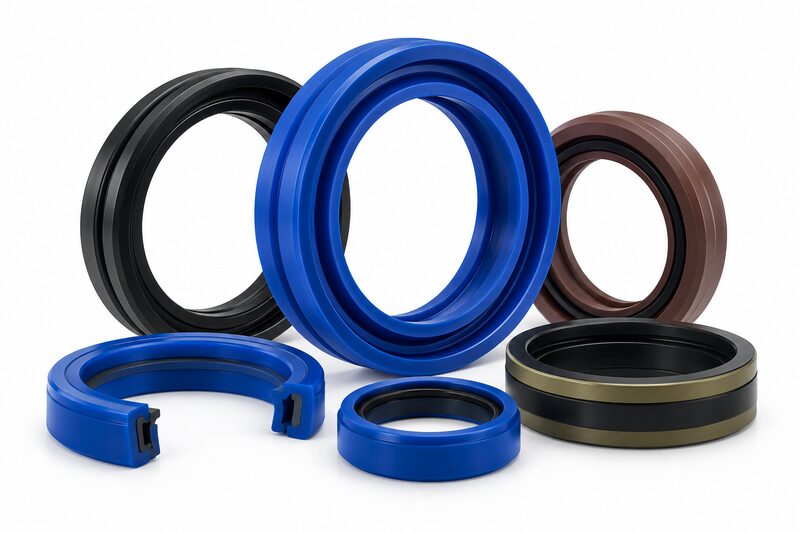
FITCO hydraulic and pneumatic seals

Piston seals, rod seals and wiper seals for hydraulic and pneumatic cylinders.

Overview

What it is

This is the family of seals fitted inside a hydraulic or pneumatic cylinder — rod seals, piston seals, wiper seals and wear rings — each doing a distinct job around the reciprocating piston and rod assembly.

The piston seal separates the cylinder's two pressure chambers as the piston moves; the rod seal (in the cylinder head) keeps pressurised fluid from leaking past the rod to atmosphere; the wiper seal, outermost in the head, scrapes contamination off the rod as it retracts; and wear rings (guide rings) carry the radial load of the piston and rod, preventing metal-to-metal contact with the bore.

Why use it

Key benefits

  • Purpose-built profile for each function rather than one generic seal doing every job
  • Designed as a matched set for a given cylinder bore and rod diameter
  • Available for both hydraulic (oil-filled) and pneumatic (air-filled, lower-friction) duty

Materials

Which compound, and why

Material

NBR (Nitrile / Buna-N)

General-purpose hydraulic seal compound, oil and moderate-temperature service.

Material

FKM / FPM (Fluoroelastomer)

High-temperature or aggressive-fluid hydraulic service.

Material

PTFE (Virgin, Glass, Bronze, Graphite)

Piston rings and rod seals in high-speed or high-temperature applications needing very low friction.

Applications

Where it's used

Hydraulic cylinders, pneumatic actuators, and mobile and industrial equipment. See the dedicated Rod Seals, Piston Seals, Wiper/Dust Seals and Pneumatic Seals pages for each element individually.

Complete Hydraulic Sealing Systems

A hydraulic cylinder requires a coordinated system of seals working together — not just a single seal. A typical cylinder assembly includes a piston seal (retains pressure), rod seal (prevents external leakage), wiper seal (excludes contaminants), guide rings (absorbs side loads), and often a buffer seal (protects the rod seal from pressure spikes). Each seal type is optimised for its specific function, and the performance of the complete system depends on correct selection and sizing of every component.

FITCO engineers can specify the complete sealing system for your cylinder based on operating parameters: bore diameter, rod diameter, stroke, operating pressure, speed, temperature range, fluid type and duty cycle. We supply individual seals or complete seal kits, and maintain stock of common sizes for fast delivery.

Hydraulic vs Pneumatic Seal Selection

Hydraulic seals typically operate at 100–350 bar (some up to 700 bar), at speeds of 0.1–0.5 m/s, with oil providing lubrication. The primary concerns are pressure resistance, extrusion prevention and controlled leakage. Pneumatic seals operate at 2–10 bar, at speeds up to 1.5 m/s, with no inherent lubrication from the sealing medium. The primary concerns are low-friction performance, stick-slip prevention and reliable sealing at very low pressures. Material selection, lip geometry and surface finish requirements differ significantly between the two applications.

Get a quote on your O-ring or sealing requirement

Send drawings, sizes, materials or an existing part number — our engineering team will respond with pricing, lead time and technical guidance.

Request a Quote Browse Technical Resources