Home/Products/X-Rings (Quad Rings)

Product

X-Rings (Quad Rings)

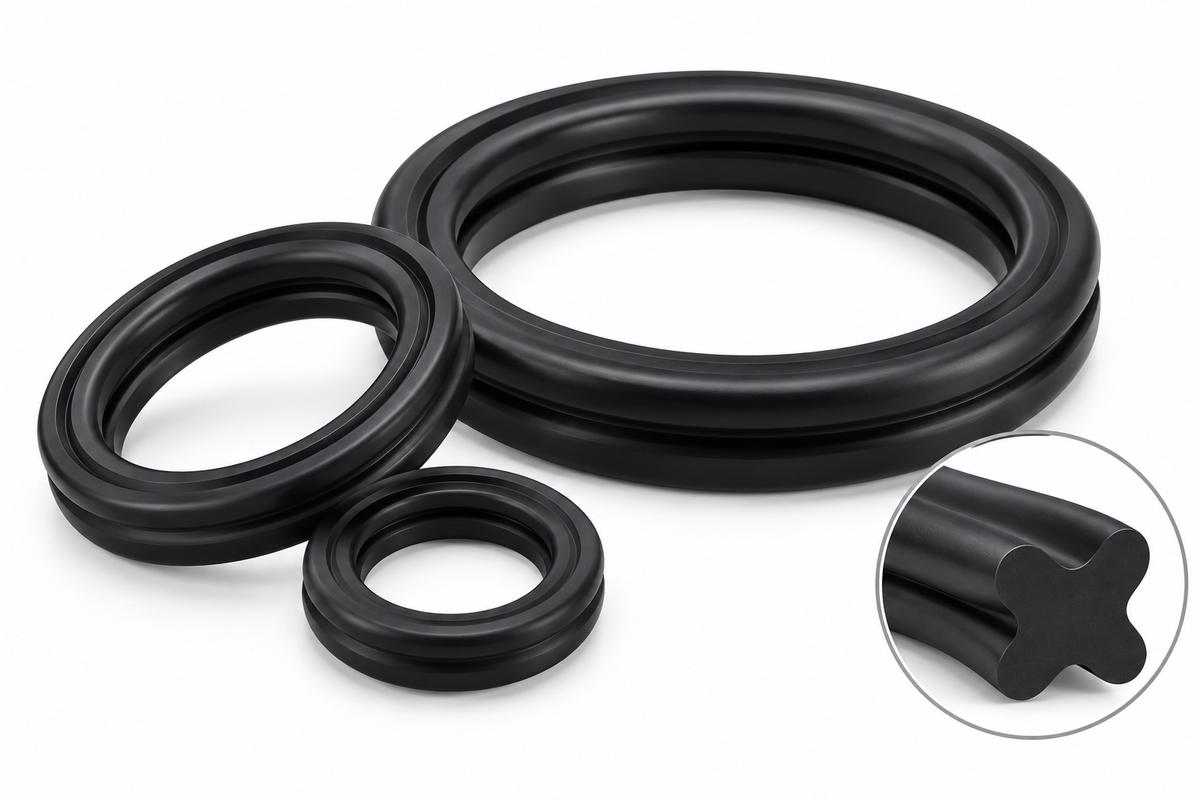
Four-lobed cross-section seals that reduce spiral twist in dynamic applications and provide two sealing lines per side compared to a standard O-ring, at lower compression force.
Reciprocating hydraulic cylinders, dynamic rotary seals, static applications needing double sealing contactTypical applications
FITCO X-rings and quad rings

X-rings (quad rings) with four-lobed cross-section for superior sealing performance.

Overview

What it is

An X-ring (also called a quad ring) is a molded elastomer seal with a four-lobed cross-section instead of the O-ring's round one. The four lobes give the ring two separate sealing surfaces on each side of the groove instead of one.

Because the cross-section has two contact points per side rather than a single round contact patch, an X-ring seals with a lower squeeze force than an equivalent O-ring for the same leak-tightness — and because the lobes resist rolling in the groove during motion, X-rings are far less prone to the spiral-twist failure that shortens O-ring life in reciprocating (dynamic) applications.

Why use it

Key benefits

  • Two sealing surfaces per side — redundancy if one contact point is damaged
  • Lower compression force needed for the same seal
  • Resists spiral twist in dynamic/reciprocating service
  • Drop-in replacement for an O-ring in most standard grooves

Materials

Which compound, and why

Material

NBR (Nitrile / Buna-N)

General-purpose dynamic and static duty, the default X-ring compound.

Material

FKM / FPM (Fluoroelastomer)

High-temperature or oil/fuel-exposed dynamic seals.

Material

EPDM

Water, steam or brake-fluid service where petroleum-oil resistance isn't needed.

Applications

Where it's used

Reciprocating hydraulic cylinders, dynamic rotary shaft seals, and static applications that benefit from the double sealing line.

X-Ring vs O-Ring — When to Choose a Quad Ring

X-rings (quad rings) provide significant advantages over standard O-rings in dynamic applications. The four-lobed cross section creates two separate sealing lines on each face — giving four sealing surfaces compared to two for an O-ring. This double-contact geometry provides more stable sealing with less friction, less tendency to twist or roll in the groove, and better resistance to spiral failure in long-stroke reciprocating applications.

X-rings generate approximately 50% less friction than O-rings of the same cross section because the four lobes distribute the sealing load over a wider contact area. They also require less squeeze — typically 10–15% versus 15–25% for O-rings — which further reduces friction and extends service life. In reciprocating hydraulic applications, X-rings can double the seal life compared to a standard O-ring.

Sizing and Interchangeability

X-rings are directly interchangeable with O-rings in standard AS568 and metric grooves — the same groove dimensions accommodate both profiles. This means X-rings can be retrofitted into existing equipment as a drop-in upgrade without any hardware modification. The four-lobed cross section also provides better groove fill, reducing the risk of seal extrusion at high pressures.

Get a quote on your O-ring or sealing requirement

Send drawings, sizes, materials or an existing part number — our engineering team will respond with pricing, lead time and technical guidance.

Request a Quote Browse Technical Resources