
Home/Products/Rod Seals

Product

Rod Seals

A rod seal sits in the cylinder head housing and seals against the reciprocating piston rod as it moves in and out — the seal most directly responsible for keeping hydraulic fluid inside the cylinder rather than leaking to atmosphere.
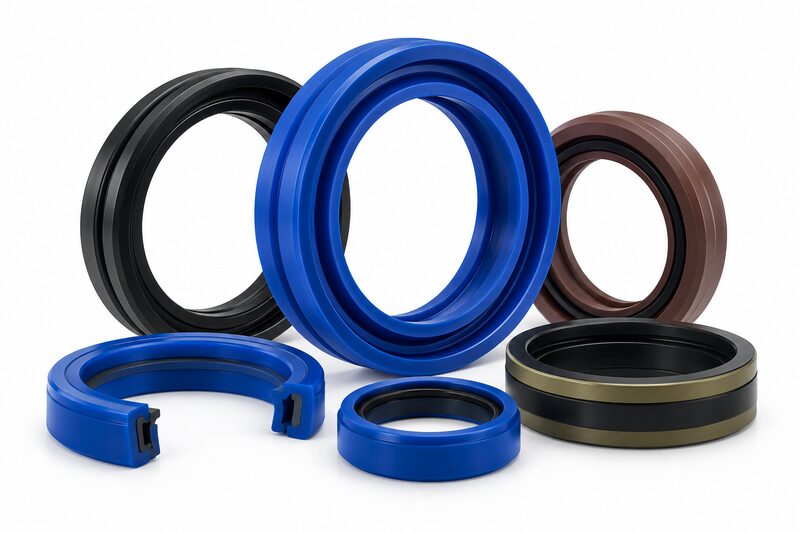
FITCO hydraulic and pneumatic seals
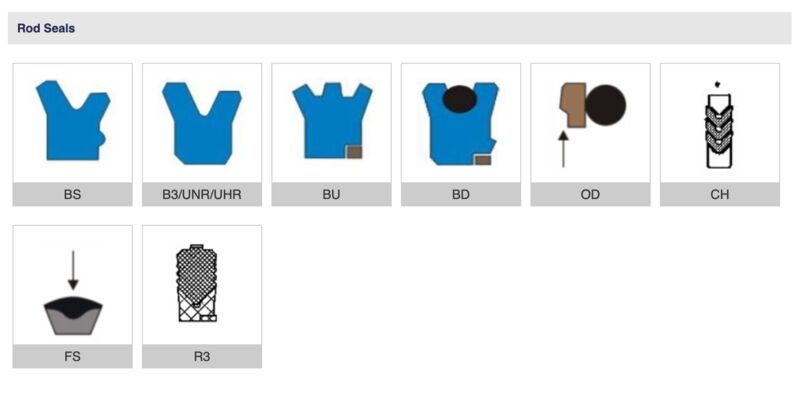
Rod seal profiles - BS, UNR/UHR, BU, BD, OD, CH, FS, R3 types

Rod seal profiles: BS, B3/UNR/UHR, BU, BD, OD, CH, FS, and R3 types.

Overview

How it works

The rod seal maintains continuous sealing contact with the rod's outside diameter across its full stroke, in both directions of travel and under working pressure — unlike a static seal, it must keep sealing while sliding, which is why rod-seal profiles are engineered for low friction and long wear life rather than maximum squeeze. A thin oil film is deliberately left on the rod as it extends, both lubricating the seal and preventing it from running dry.

Profiles

Available profiles

Profile

RS — Compact Rod Seal

Single-element compact profile for standard-duty hydraulic cylinders.

Profile

SPGO

Polyurethane rod seal with an integral dust-lip function in a single component.

Profile

CH — Step Seal

Two-piece PTFE/elastomer step-seal design for high-pressure, high-speed service.

Materials

Which compound, and why

Material

Polyurethane (PU)

The default rod-seal material — high tensile strength and extrusion resistance under working pressure.

Material

NBR

Lower-cost option for moderate-pressure, moderate-temperature duty.

Material

FKM (Viton)

High-temperature service or synthetic/aggressive hydraulic fluids beyond PU or NBR's range.

Applications

Where used

Fitted in the cylinder head of hydraulic cylinders across mobile equipment, industrial presses and machine tools — anywhere a piston rod reciprocates under pressure.

How Rod Seals Work

A hydraulic rod seal sits in a groove machined into the cylinder head (gland) and seals against the piston rod as it extends and retracts. The seal must withstand system pressure on one side while maintaining a controlled oil film on the rod surface to lubricate itself and the wiper seal. A well-designed rod seal allows a microscopically thin oil film to pass outward on the extension stroke and recovers it on the retraction stroke, achieving near-zero leakage under dynamic conditions.

Rod seals operate under demanding conditions — they must handle pressure spikes, variable speeds, side loads on the rod, and temperature cycling while maintaining a reliable seal over millions of cycles. The seal profile, material hardness and groove geometry all influence leakage rate, friction and service life.

Rod Seal Profiles and Selection

U-Cup seals (UHS/UNS) are the most common hydraulic rod seal, offering excellent pressure resistance up to 400 bar with a simple single-piece design. They are self-activating — system pressure spreads the lips for tighter sealing at higher pressures. Buffer seals (BS) are installed upstream of the primary rod seal to absorb pressure peaks and reduce the pressure differential across the main seal, extending its life in systems with frequent pressure spikes.

Step seals (BU) combine a PTFE sliding ring with an elastomer energiser, delivering very low friction and long life at pressures up to 700 bar. They are ideal for servo-hydraulic and precision positioning cylinders. Compact seals (B3/UNR/UHR) fit in narrow grooves and are used where installation space is limited. For heavy-duty applications above 400 bar, multi-component sealing systems combining a primary seal with backup rings provide the most reliable performance.

Technical Specifications

FITCO rod seals cover rod diameters from 8 mm to 200 mm with operating pressures up to 700 bar depending on the profile. Standard operating temperature range is –30 °C to +110 °C for NBR, –20 °C to +200 °C for FKM, and –50 °C to +250 °C for PTFE seals. Rod surface finish should be Ra 0.1–0.3 µm with hardness of 55–65 HRC minimum. Rod seals are typically manufactured in polyurethane (PU), NBR, FKM, or PTFE compounds depending on the application requirements.

📐 Rod Seal Size Chart Request a Quote

Get a quote on your O-ring or sealing requirement

Send drawings, sizes, materials or an existing part number — our engineering team will respond with pricing, lead time and technical guidance.

Request a Quote Browse Technical Resources