Product
Piston Seals
A piston seal seals the moving piston against the cylinder bore, separating the two pressure chambers of a double-acting hydraulic cylinder so fluid can't bypass from the high-pressure side to the low-pressure side.
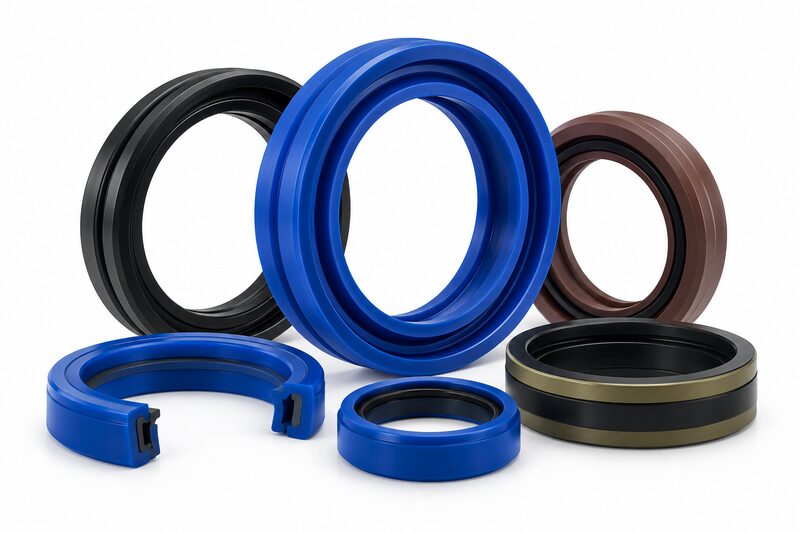
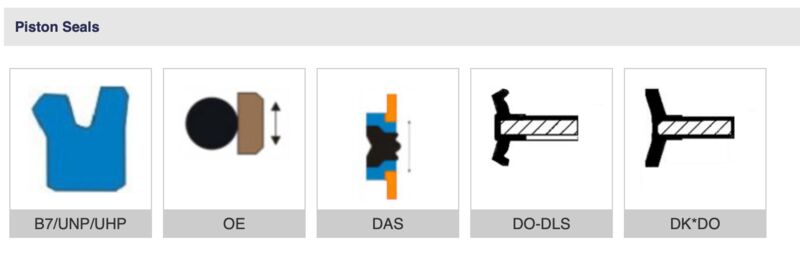
Piston seal profiles: B7/UNP/UHP, OE, DAS, DO-DLS, and DK*DO types.
Overview
How it works
Unlike a rod seal, which seals against a fixed housing while the rod moves through it, a piston seal moves with the piston through a fixed bore — so it has to seal reliably at every point along the stroke, not just at rest. Internal (cross-port) leakage past a worn piston seal is one of the most common causes of a hydraulic cylinder losing holding force under load, which is why piston-seal wear life is usually the limiting factor in a cylinder's service interval.
Profiles
Available profiles
PS1
Single-element compact piston seal profile for standard-duty cylinders.
DA — Double Acting
Symmetrical profile sealing equally in both directions of travel.
PR — Piston Ring
PTFE-based ring style for high-speed or high-temperature service.
Materials
Which compound, and why
Polyurethane (PU)
The default piston-seal material — extrusion and wear resistance under working pressure.
PTFE (Virgin, Glass, Bronze, Graphite)
Piston-ring profiles in high-speed or high-temperature service needing very low friction.
Applications
Where used
Fitted around the piston of double-acting hydraulic cylinders across mobile equipment, industrial presses and machine tools.